Meta's 'Watermelon' Just Claimed GPT-5.5 Parity. Here's What's Actually Going On
If you spent any time on AI Twitter, Threads, or Instagram this week, you ran straight into one of the strangest headlines of 2026: Meta's next frontier AI model, codenamed "Watermelon," has reportedly caught up to OpenAI's GPT-5.5.
Yes. Watermelon. And somehow, the name isn't even the strangest part.
The claim traces back to an internal Meta town hall on July 2, where Meta Superintelligence Labs chief Alexandr Wang reportedly told staff that Watermelon, a model that's still in training, already matches GPT-5.5 on several benchmarks Meta watches closely internally. There's just one catch: nobody outside Meta has actually seen those benchmarks.
So is this another AI hype cycle, or is Meta quietly buying its way back into the frontier race? Let's unpack what actually matters.

The short version
- What: Meta says its in-training model "Watermelon" matches GPT-5.5 on internal benchmarks.
- The catch: those benchmarks were never named or made public.
- The real headline: Watermelon reportedly used 10x more compute than Meta's last model.
- Should you believe it? Not yet, but you shouldn't ignore it either.
What is Meta's "Watermelon" AI?
According to reporting from Business Insider, Wang told employees that Watermelon, the successor to Meta's internal "Avocado" model, has reached parity with GPT-5.5 on the metrics Meta tracks internally.
The benchmarks themselves were never disclosed. And in AI, a benchmark claim with no benchmark name is basically the polished version of "trust me, bro."
But one line from Wang did stand out, and it's arguably the actual story:
"Watermelon uses an order of magnitude more compute than Avocado."
The fruit basket is getting expensive
Meta's internal naming scheme now reads like someone wandered into a grocery store:
- Avocado shipped publicly as Muse Spark in April 2026.
- Watermelon is the next-gen frontier model, still training.
The memes write themselves. But underneath the produce aisle is a genuinely serious strategy. Watermelon isn't being framed as an incremental bump. Wang reportedly said Meta increased training compute roughly 10x over Avocado, and in frontier AI, a tenfold jump in compute isn't a version update. It's a declaration of war.
Why the "10x compute" number matters more than GPT-5.5
Here's the thing about benchmarks: they can be selected. Compute budgets can't.
When a lab says it spent an order of magnitude more compute, what it's really telling you is: more GPUs, larger clusters, longer training runs, bigger infrastructure bets, and a willingness to burn billions chasing capability. Meta has told investors it expects to spend between $125 billion and $145 billion on AI infrastructure, chips, and data centers in 2026 alone.
That's not "we're experimenting." That's "we're rebuilding the company around AI."
Meta's real advantage isn't compute. It's data
Everyone obsesses over GPUs. Almost nobody talks about the thing that should actually keep competitors up at night: data.
Unlike OpenAI or Anthropic, Meta owns platforms used by billions of people every single day: Facebook, Instagram, WhatsApp, and Threads. No other AI company sits on that scale of real-world human interaction.
To be clear, Meta has never publicly confirmed that Watermelon is trained on any of this. But the mere possibility is the point. Compute can be purchased. A data monopoly can't.
Why everyone is (rightly) still skeptical
Refreshingly, the internet's reaction has been pretty level-headed. The criticism boils down to three questions.
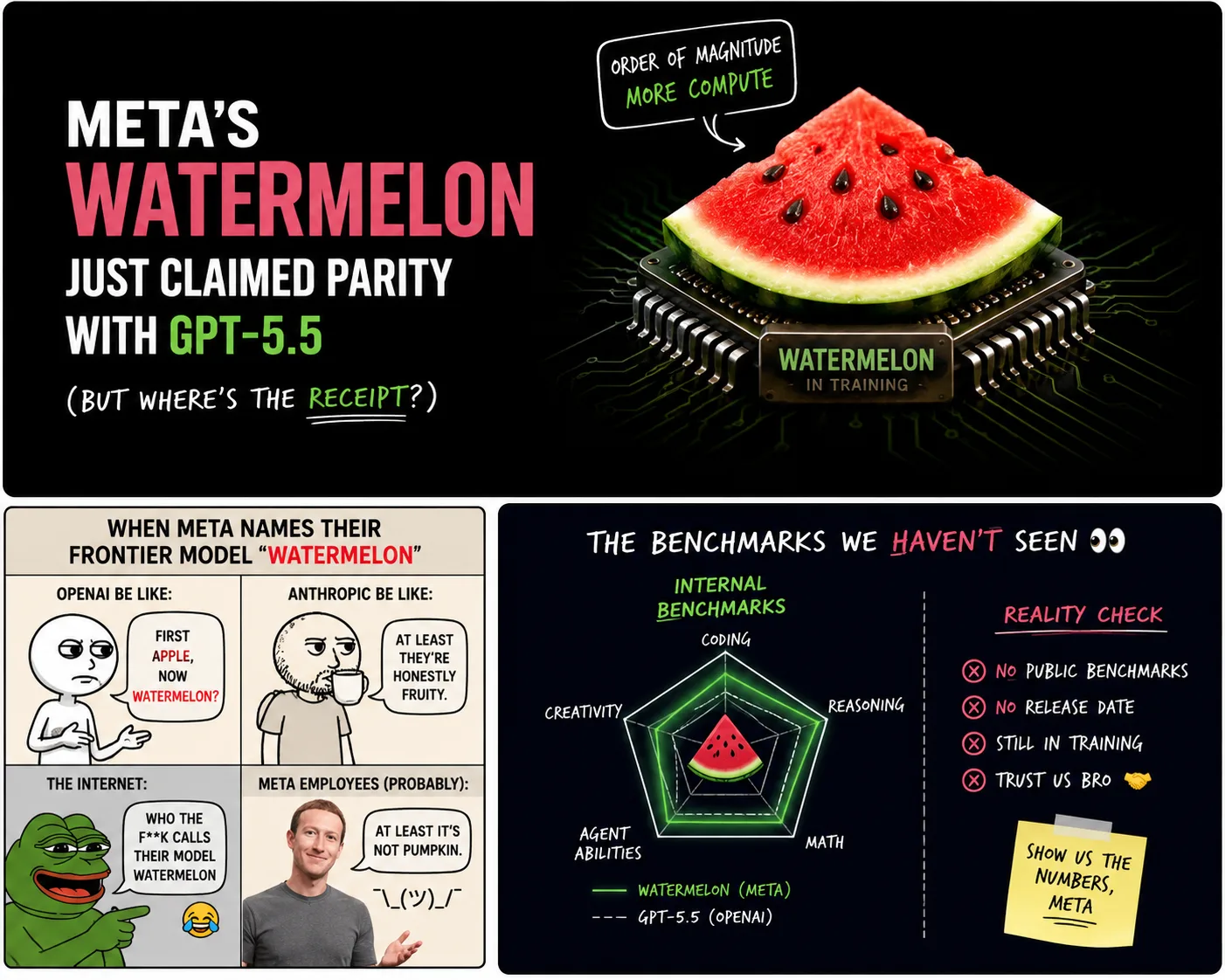
1. Where are the benchmarks? Wang said Watermelon matches GPT-5.5, but not on what. Until those numbers are public, this stays an internal claim.
2. Is GPT-5.5 even the right target anymore? OpenAI shipped GPT-5.5 back in April and has already previewed GPT-5.6. Catching a model from a few months ago is impressive; leading the frontier is a different game entirely.
3. Why is it called Watermelon? Honestly? This might be the strongest criticism. "We've reached the produce-aisle phase of AGI" is difficult to argue with.
The most interesting part wasn't Wang
During that same meeting, Mark Zuckerberg reportedly struck a far more cautious tone, acknowledging that Meta's broader AI ambitions haven't fully materialized yet.
That's the real tension worth watching. On one side, Wang says Meta has caught GPT-5.5. On the other, Zuckerberg admits the strategy hasn't delivered everything they'd hoped. Internal confidence, external caution. And usually, when both show up at once, something important is happening under the surface.
So, should you believe the Watermelon hype?
Not yet. Right now there's:
- ❌ No public model
- ❌ No independent benchmarks
- ❌ No release date
- ❌ No third-party evaluation
But there's one thing we do know: Meta is spending at a scale almost no company on Earth can match. And historically, when a company with billions of users, near-unlimited compute, and a founder willing to spend hundreds of billions decides to compete seriously, everyone else eventually has to pay attention.
Watermelon might turn out to be another overhyped internal project. Or it might be the first sign that Meta has finally stopped playing catch-up. Either way, the AI race just got a lot more interesting.
Frequently asked questions
What is Meta's Watermelon AI model?
"Watermelon" is the internal codename for Meta's next-generation frontier AI model, successor to the "Avocado" model (released publicly as Muse Spark). As of early July 2026 it's still in training and has not been released.
Is Watermelon better than GPT-5.5?
Meta reportedly claims internal parity with GPT-5.5, not that it's better. Those benchmarks haven't been published or independently verified, so the claim can't be confirmed yet.
When will Meta release Watermelon?
There's no announced release date. Meta has described it only as still in training.
Why is Meta's AI model called Watermelon?
It's an internal codename, following Meta's fruit-and-vegetable naming pattern (Avocado came before it). Meta hasn't explained the theme, which is exactly why the internet has had so much fun with it.
Watermelon already broke AI Twitter before it even exists. Want to stage your own reaction post or "leaked" hot take? Make a realistic fake tweet, free and no login →